

The SuperVendor Era is Here. Payments & checkout is where it begins.
The 13th annual Dykema DSO Conference just wrapped in Denver. For anyone outside the vertical, Dykema is a national law firm with one of the most active DSO legal practices in the country. Dykema’s DSO Industry Group hosts what has become the definitive annual gathering for organized dentistry.
Before the conference kicked off, Matt McGaw of DSO Compass made the case that the DSO technology conversation is moving from "what does this one tool do" to "how does it fit into everything else we're running and how much can it do." Costs are adding up, executives are juggling more priorities, and point solutions are being evaluated and cut. After three days of conversations with clients and dental leaders in Denver, it's hard to disagree.
The SuperVendor thesis is taking shape.
Other companies in the dental vertical like Dandy are moving toward bundling and partnering with best-in-class solutions across the dental stack to deliver a unified experience. It's a smart instinct, and it's the same one the biggest technology companies built their businesses on.
Microsoft didn't become what it is today with the best word processor or the best spreadsheet program. They positioned themselves well by bundling Word and Excel into Office and owning the entire workflow. Google ran the same play on the productivity side. Gmail, Drive, Docs, and Calendar were never the best individual tools, but one login and one place where everything talks to each other made them the default for a generation of businesses.
Private equity has recognized this pattern in every vertical it touches. Procore consolidated construction point solutions and became a $10B+ company. Rippling is making the same argument in HR right now. The thesis is always the same: whoever owns the workflow ends up succeeding.
Healthcare and dental are next. The main question is which category goes first.
Conference Observations
Jill Dunnam and Beenit Patel at Allied OMS said to us: the goal right now is to reduce the number of tools their practices are required to use and standardize behavior across locations. Not evaluate more vendors but consolidate the ones they have.
Christina Carlson at Lone Peak added a dimension to this thinking. Implementation quality and working collaboratively with a partner on continued development and mutual enhancements of the service is what is important as they look to adopt new technology solutions. A product that works but leaves your team unsupported is almost worse than not having it at all.
The throughline is consistent across this vertical and others. DSO leaders are done collecting point solutions. They want fewer relationships, simpler workflows, shorter P&Ls and vendors with the partnership mentality.
From a PE perspective this carries weight. Stack too many point solutions across a portfolio and you're not building a scalable platform. Every additional tool is another integration to maintain, another vendor to manage, another training cycle to run at each new acquisition. The operational drag compounds until you're staring at a margin problem you can't easily fix.
Point-solution problems in patient financing
Patient financing is one of the most fragmented categories in dental operations, and arguably one of the most consequential for revenue.
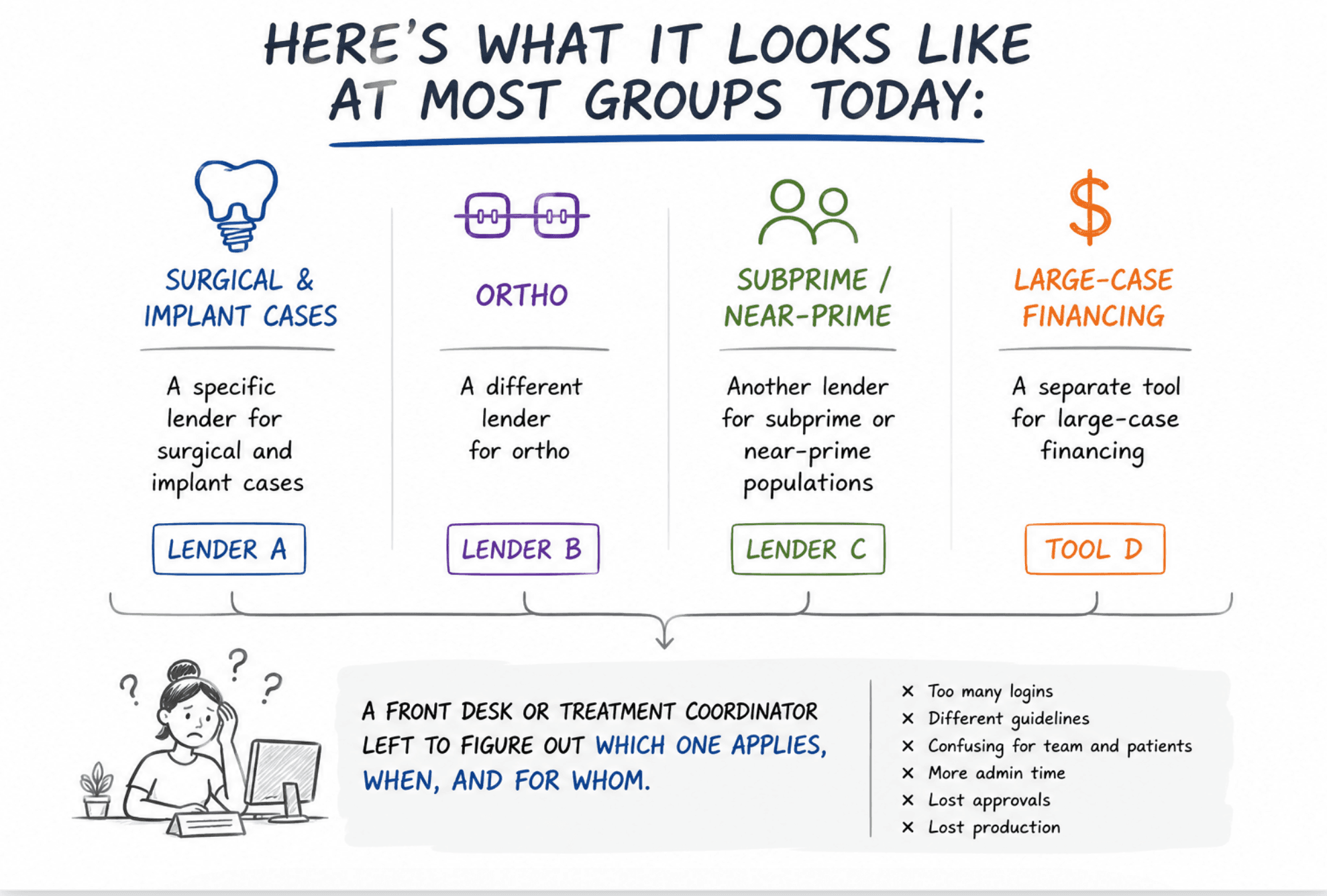
Here's what it looks like at most groups today:
-
A specific lender for surgical and implant cases
-
A different lender for ortho
-
Another for subprime or near-prime populations
-
A separate tool for large-case financing
-
A front desk or treatment coordinator left to figure out which one applies, when, and for whom
The result is that your treatment coordinator is being asked to act like an accountant, mentally mapping patient credit profiles to lender appetite in real time, under pressure, while a patient is sitting across from them.
It rarely works, and the cost is twofold: cases that don't convert and patients who don't get care.
Lenders also move. CareCredit received a consent order in 2012 and pulled out of several markets overnight. Allied Bank exited the medspa space entirely after owning it for years. GreenSky, similar story. When a portfolio is built around a single lender relationship, those exits create real pain. With a properly sequenced multi-lender stack, your team doesn't feel it because the platform routes around it automatically.
Our Founding Insight
Endeavor co-founder Jeremiah Cole saw this problem up close before starting the company. As Head of Consumer Finance at LaserAway, he scaled a financing aggregator across more than 150 locations and processed over $2 billion in loans. What he found at nearly every location was a different financing experience. Different lenders, different workflows, different outcomes, and no way to know what was working or why.
That inconsistency was the founding insight. If the flow is not standardized, you cannot improve it. If you cannot improve it, you are leaving conversion on the table at every single location, indefinitely.
The same lesson applies at the portfolio level. PE-backed DSOs making acquisitions every quarter cannot afford to inherit a different financing workflow at each new practice. The integration cost alone erodes the thesis.
What we built
One dashboard with one application flow. Every lender, prime, near-prime, subprime, large-case specialists, evaluated automatically in the background based on rules the organization sets upfront.
The treatment coordinator does not need to know which lender handles which credit profile. The platform handles the sequencing and the patient gets the best available option for their situation. The practice gets the full treatment amount funded, or as close to it as possible, without adding complexity to the front desk. The patient gets their much-needed care.
It works across surgical and implant cases, general dentistry, and ortho. Our underlying logic adapts to case size, credit profile, and lender availability in real time. We own the workflow, so we can see across all of it: which lenders are converting, where partial fills are happening, which locations have accommodation rates below threshold. That visibility does not exist when financing is spread across four disconnected point solutions.
The Thesis Is Taking Shape
Other companies didn't succeed on the strength of one good product. They grew by providing a great workflow and making everything simpler for the people using it.
The SuperVendor era in dental will reward the same things: simplicity, measurable outcomes, and partners who stay invested in the outcomes for the DSO and the patient. Patient financing, one of the highest-leverage levers in case conversion, is still being run as a patchwork of point solutions at most groups.
That is the problem we exist to fix. Based on what we heard at Dykema, the market is ready.
Other companies in the dental vertical like Dandy are moving toward bundling and partnering with best-in-class solutions across the dental stack to deliver a unified experience. It's a smart instinct, and it's the same one the biggest technology companies built their businesses on.
Microsoft didn't become what it is today with the best word processor or the best spreadsheet program. They positioned themselves well by bundling Word and Excel into Office and owning the entire workflow. Google ran the same play on the productivity side. Gmail, Drive, Docs, and Calendar were never the best individual tools, but one login and one place where everything talks to each other made them the default for a generation of businesses.
Private equity has recognized this pattern in every vertical it touches. Procore consolidated construction point solutions and became a $10B+ company. Rippling is making the same argument in HR right now. The thesis is always the same: whoever owns the workflow ends up succeeding.