

There is a moment in every practice, several times a day in fact, that shapes your same-store number more than any marketing spend or acquisition ever will. The dentist finishes the exam and lays out a treatment plan that is clinically sound. The patient understands it and, more often than not, wants it. Then the conversation turns to money, and somewhere between the operatory and the front desk the plan quietly dies.
Nobody logs it as a loss, and no report captures it. The patient thanks the coordinator, says they will think about it, and walks out with a treatment plan in hand and no appointment on the books, while the doctor moves on to the next room and the day carries on as if nothing happened.
I have spent the better part of a decade in medical and dental finance watching that moment play out across hundreds of practices. What has changed recently is not the moment itself but our ability to measure it, because for the first time the industry has data that puts a price on every plan that dies at the front desk.
The Growth You Already Diagnosed
When Planet DDS analyzed more than 8,500 practices across 497 dental support organizations for its 2026 Dental Industry Outlook, the headline number was one every DSO executive should read twice. The industry average case acceptance rate in 2025 was 58%, up a single point from the year before, which is progress of a sort but hardly the kind that inspires celebration. More troubling is what sits beneath that average: nearly one in ten practices is converting fewer than 30% of presented cases, which means that for every ten patients who need treatment, seven or more leave without scheduling it.
What turns that statistic into something urgent is what the same report says it is worth. A five-point improvement in case acceptance across that network would unlock roughly $1 billion a year in incremental production with no capital expenditure at all, more growth than most DSOs manage to create through acquisition. Even a single point is worth about $151 per practice per day, and none of it requires a new market, a new provider, or a new chair. It requires only that you convert more of what your doctors are already diagnosing.
That is a rare thing in this cycle. The 2026 outlook is explicit that as competition intensifies and capital markets loosen, the year will belong to organizations that drive same-store growth, adopt technology well, strengthen culture, and expand with discipline. Every DSO has that first item on the whiteboard, but far fewer have identified a lever that moves it without adding cost to the P&L. Case acceptance is that lever, and it is sitting inside buildings you already own.
Where the Plan Actually Dies
The data is uncomfortably precise about where the leak begins. Cases under $50 are accepted at nearly 83% by dollar value, but by the $300 to $500 tier that figure has fallen to 46%. Patients are not losing faith in the diagnosis somewhere along that curve. They are simply reaching the point where the number on the treatment plan becomes a real financial decision, and that is where the yes turns into a maybe.
Unfortunately, that is also where your economics live. Implants alone account for roughly $256 million in the network at $1,351 per case, and the report puts their leverage in plain terms: one implant is worth about 22 preventive visits in revenue. In other words, your highest-margin production is concentrated in exactly the tier where acceptance collapses. The volume engine converts beautifully while the value engine stalls.
So the plan is not dying in the operatory. It is dying at the exact moment a patient is asked how they intend to pay for it.
You Cannot Present Your Way Past a Cost Barrier
The industry's reflexive answer has always been better presentation, whether that means intraoral cameras, co-diagnosis, or a carefully scripted treatment conversation. All of it helps, and none of it reaches what is actually stopping the patient. A 2024 ADA Health Policy Institute report found that 13% of the population faced cost barriers to dental care, against just 4% to 5% for medical and mental health services, prescription drugs, and eyeglasses, which by that measure makes dental the most cost-rationed category in American healthcare. In a separate Synchrony study, 92% of respondents said that rising costs would make them consider holding off on dental treatment.
No camera image changes that math. The patient already believes the diagnosis; what they lack is a way to pay for it. You cannot present your way past a cost barrier. You can only finance your way past it.
Which means the question is not whether you offer financing, since almost everyone does. The question is whether the financing you offer is built to say yes to the patient in front of you.
One Lender Is Not a Financing Strategy
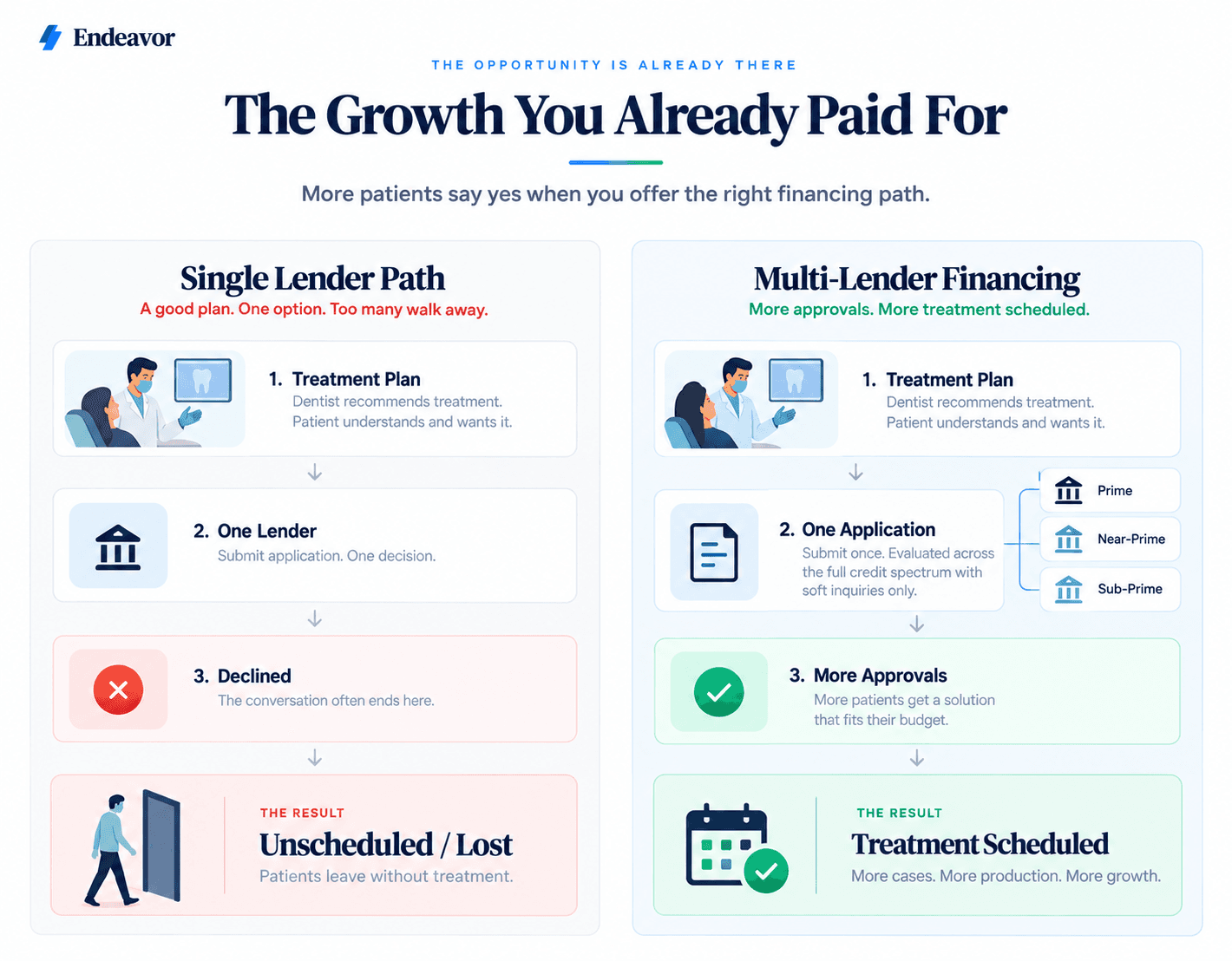
Here is what most groups are actually running today. A treatment coordinator presents one prime lender, perhaps two, and if the patient is declined, the conversation ends there. Because the second lender often shares nearly the same buy box as the first, the second attempt was never really a second attempt to begin with. A patient who falls outside the prime credit tier, which describes a large share of the patients presenting with $1,300 implant cases, gets a decline, a polite smile, and a walk to the parking lot.
That is the moment the plan dies, not because the patient did not want care, but because the practice ran out of ways to say yes.
The obvious fix is to add more lenders, and that is where groups run into the second problem. Scale three or four lenders across forty locations and the complexity compounds into three or four portals, applications, and approval flows, all landing on a coordinator who is also managing the schedule, fielding patient questions, and keeping the clinical team moving. What happens next is entirely predictable: she either learns one lender well and defaults to it for everyone, or she grows uncertain enough about the process that she stops offering financing proactively at all. Either way you are back to a single-lender strategy in practice, only now with more contracts to manage. Both outcomes show up in your same-store number, and neither one ever appears in a report labeled as a financing failure.
Why an Aggregator Is the Answer
An aggregator model solves both problems at once, which is why it is the best available strategy for case acceptance.
On the patient side, it fixes the decline. The patient submits a single application that is evaluated across the full credit spectrum, from prime through near-prime and subprime, using soft inquiries only, so their credit is untouched unless they decide to move forward. Instead of being measured against one lender's buy box, the patient is matched against many. In the platform I work with, offer rates in a specialty like ortho routinely land between 85% and 95%, compared with the 40% to 60% a single-lender approach delivers on a good day. Run the arithmetic on that gap against the $300-plus cases where acceptance collapses, and you have found the leak.
On the practice side, it fixes the coordinator. There is one workflow to train, one process to standardize, and one set of numbers you can compare honestly across every location. The coordinator no longer has to know which lender is right for which patient, because the platform does that work for her. All she has to do is offer financing every time, and that turns out to be the single behavior that actually moves the number.
That combination is the whole point. More lenders without an aggregator means more approvals on paper and fewer in practice, because the front desk cannot run it. An aggregator without the full credit spectrum is just a nicer portal for the same decline. You need both: the breadth to say yes to the patient, and the simplicity for the team to offer it every single time.
Case Acceptance Is Only Half the Equation
I want to be clear about the limits here, because the same report is. Case completion, not acceptance, is the real bottleneck; the average completion rate was 47%, which means a great many patients say yes and then walk out without the next appointment on the books. Financing wins you the yes, and scheduling discipline is what turns that yes into production. Anyone who sells you one as a substitute for the other is selling you half a solution.
But the yes has to come first, and in most of the groups I see it is not failing for clinical reasons or for lack of a good presentation. It is failing because a patient who needed care was offered one lender, declined, and sent home.
Every DSO is hunting for same-store growth, and yours is standing at the front desk right now, holding a treatment plan it wants and waiting for a second financing offer that never comes. Give your coordinators one application that reaches every lender, so that patients can say “yes” to the treatment they want and need.